
Shadab Khan & Haris Rauf's Record-Breaking 8th-wicket Partnership

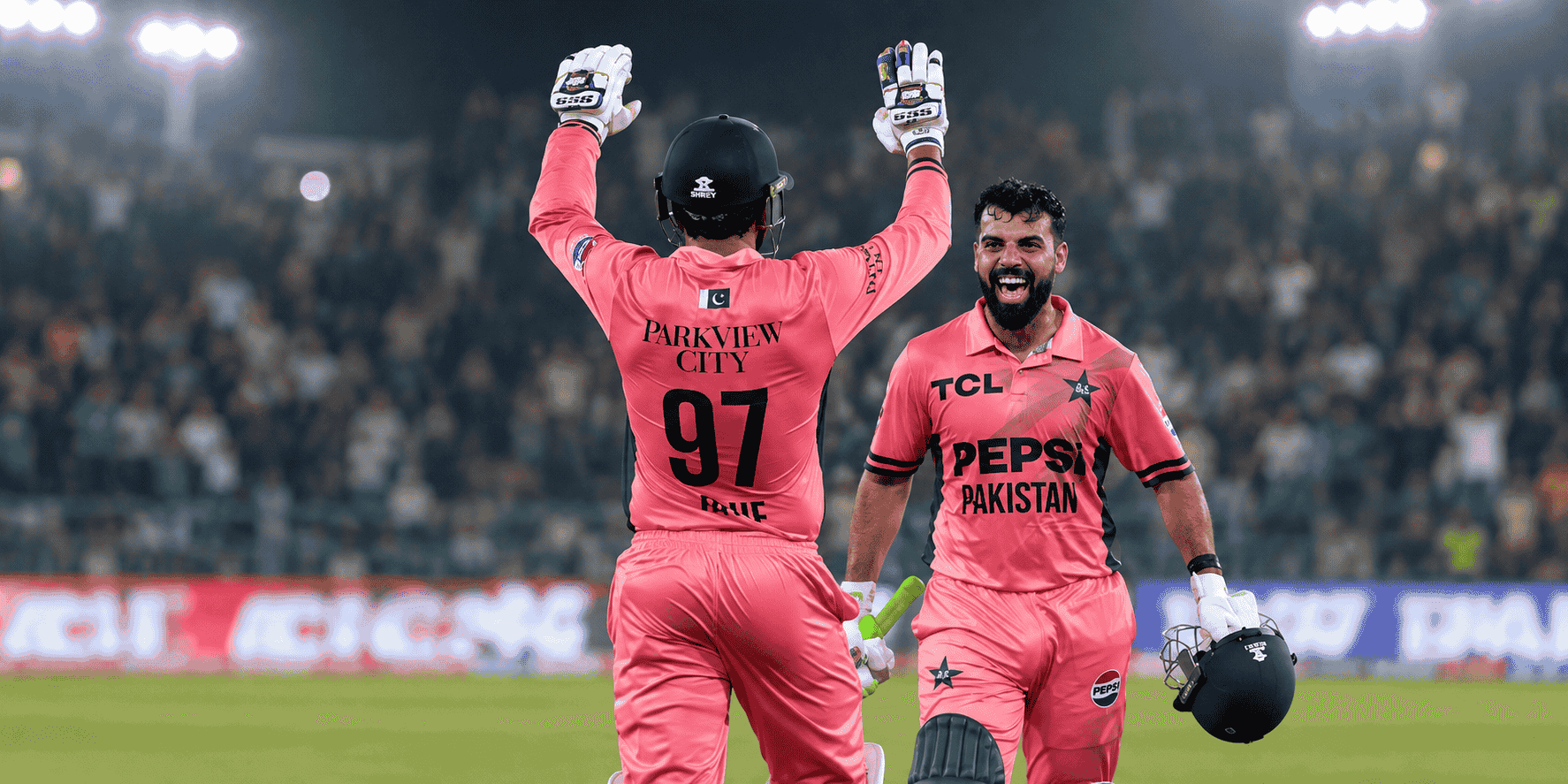
Cricket sometimes produces moments that keep fans glued to their screens until the very last ball. The ODI Tri-Series match between Pakistan and England, played at Gaddafi Stadium in Lahore on October 25, 2026, was one such unforgettable contest.
Pakistan needed 242 runs to win, but England appeared to be in control of the match at one stage. Pakistan had already lost several important wickets. Salman Ali Agha and Hasan Nawaz both attempted big shots but ended up giving away their wickets after being caught. Captain Shaheen Shah Afridi, who was expected to play a responsible innings, also tried to attack from the beginning. After hitting one four, he was caught off Jamie Overton's bowling and had to return to the pavilion.
Razaullah then struck an impressive six, but he was dismissed by Will Jacks. Pakistan had lost nine wickets for just 154 runs, and the match appeared almost over. At this difficult moment, Shadab Khan and Haris Rauf came together at the crease and completely changed the course of the game.
The two players built a historic 89-run partnership for the last wicket. Shadab Khan scored an unbeaten 113 runs, while Haris Rauf remained not out on 7 runs off 19 balls, playing an important role in Pakistan's unforgettable victory.
Pakistan defeated England by just one wicket and qualified for the Tri-Series final. This partnership was not just a match-winning stand; it was also a remarkable example of fighting under pressure.
The match between Pakistan and England was the fourth game of the ODI Tri-Series. England batted first and scored 241 runs in 46.4 overs, setting Pakistan a target of 242 runs.
Pakistan's run chase initially showed some promise, but regular wickets put the team under increasing pressure. England's bowlers did not allow Pakistan's middle order much time to settle at the crease.
Pakistan's score reached 154/9, and victory seemed increasingly difficult. However, Shadab Khan remained confident in his batting and, together with Haris Rauf, completed an extraordinary comeback through a last-wicket partnership.
Here is the information organized in a clean, easy-to-read table:
| Match Category | Details |
| England Innings | 241 all out (46.4 overs) |
| Pakistan Innings | 243/9 (47.1 overs) |
| Match Result | Pakistan won by 1 wicket |
| Player of the Match | Shadab Khan |
| Venue | Gaddafi Stadium, Lahore |
| Date | October 25, 2026 |
According to the Pakistan Cricket Board, Shadab and Haris's 89-run partnership set a record for the highest tenth-wicket stand in a successful ODI run chase.
England's Batting: Ben Duckett's Important Century
England posted a challenging total after batting first. Their innings did not get off to an easy start, as Pakistan's bowlers took early wickets and put the visitors under pressure.
Ben Duckett was England's most important batter. He scored 105 runs off 111 balls, including 10 fours and two sixes. His century helped England recover from a difficult position and gave the team hope of posting a competitive total.
Sam Curran also made a useful contribution, scoring 42 runs off 52 balls. Both batters attempted to provide stability to England's innings.
Captain Harry Brook, who had scored a double century in the previous match, managed just one run this time. Six England batters failed to reach double figures. Tom Banton scored four runs, Joe Root made five, and Brook was dismissed for just one. The middle and lower order also struggled, with Jordan Cox scoring six, Liam Dawson making five, and Henry Crocombe adding eight runs.
As a result, England failed to establish a much bigger total and were bowled out for 241 runs.
For Pakistan, Shaheen Shah Afridi took four wickets, while Arafat Minhas and Razaullah claimed two wickets each.
Pakistan's Run Chase: Wickets Increased the Pressure
Chasing a target of 242 runs, Pakistan needed a stable batting performance. However, England's bowlers took early breakthroughs and pushed Pakistan into a difficult position.
Fakhar Zaman scored 10 runs, Saim Ayub made six, and Babar Azam also managed just 10 runs. Once again, Pakistan's top-order batters failed to produce substantial scores and were dismissed early, putting the team under pressure.
Saad Baig then scored 32 runs, while Salman Ali Agha made 26 and Hasan Nawaz contributed 15. Arafat Minhas managed only one run.
Shadab Khan played a brilliant innings of 113 not out. Shaheen Shah Afridi scored four runs, Razaullah made eight, and Haris Rauf remained unbeaten on seven.
Pakistan lost its ninth wicket at 154 runs in 33.5 overs.
Shadab tried to hold the innings together, but his batting partners continued to fall at regular intervals.
At 154/9, Pakistan needed another 88 runs to win, with only one wicket remaining. England were in a strong position to secure victory.
However, cricket is an unpredictable game, and Shadab Khan and Haris Rauf proved that once again.
Shadab Khan's Incredible Unbeaten 113 Runs
Shadab Khan delivered an exceptional performance with the bat. He scored an unbeaten 113 runs off 96 balls, including 13 fours and five sixes.
The most impressive aspect of his innings was his ability to maintain focus under pressure. As wickets continued to fall, Shadab identified scoring opportunities and did not hesitate to play attacking shots against England's bowlers.
He did not rely solely on defensive cricket. He struck boundaries when necessary and kept the scoreboard moving. Alongside Haris Rauf, he also managed the strike intelligently, retaining most of it while taking singles every four or five balls when appropriate.
His century was his maiden century in international cricket, making the achievement even more special.
The significance of Shadab's innings went beyond his 113 runs. His performance reignited the passion and excitement of Pakistan's cricket fans. This innings is likely to remain memorable for a long time.
Haris Rauf's Crucial Support in the Historic Partnership
While Shadab Khan controlled the match with his batting, Haris Rauf played an important role in Pakistan's victory by supporting him during a difficult situation.
Haris Rauf is primarily known as a fast bowler, but in this match, he showed patience and determination as a lower-order batter. When he came to the crease, Pakistan had only one wicket remaining, and England needed just one more wicket to win.
Batting in such a situation is not easy for any player. A single mistake can change the result of the entire match. Haris handled the pressure and helped build the partnership with Shadab.
He continued encouraging Shadab, assuring him that he would not get out and reminding him to protect his wicket. This confidence and belief played an important role in Pakistan's victory.
Haris scored seven not out from 19 balls. Although his individual score may not appear particularly impressive, his presence at the crease was extremely valuable to Shadab.
He contributed by protecting his wicket, rotating the strike when possible, and helping the innings progress. Eventually, Haris struck the winning boundary, giving Pakistan a historic one-wicket victory.
This performance showed that every player's contribution matters in cricket. Sometimes, one batter's century makes the headlines, but protecting one's wicket and supporting a partner at the other end can be equally crucial.
89-Run Partnership: A Record-Breaking Achievement
Shadab Khan and Haris Rauf's partnership became the most memorable moment of the match.
The two players added 89 runs for the last wicket, taking Pakistan from the dangerous position of 154/9 to victory. According to the Pakistan Cricket Board, this partnership set a record for the highest tenth-wicket stand in a successful ODI run chase.
To understand the importance of this achievement, it is essential to consider the match situation. Pakistan still needed runs to reach the target, but only one wicket remained. England's bowlers knew that taking one more wicket would secure their victory.
Despite this pressure, Shadab and Haris continued building their partnership. Shadab maintained the scoring rate through boundaries, while Haris supported him at the other end.
As the partnership grew, the pressure on England increased. A team that had appeared close to victory just a few overs earlier was suddenly struggling to defend its position.
This record-breaking stand reminded cricket fans that a match is never truly over until the final wicket falls.
The Dramatic Moment: Shadab Khan's Narrow Escape
The drama intensified during the final overs. When Shadab Khan was batting on 97, England's Gus Atkinson bowled a delivery that resulted in an LBW decision against him.
England's players began celebrating, and it appeared that the match was over. Shadab angrily struck his bat against the ground. During this moment, Haris Rauf encouraged him to review the decision.
After the review, it was found that the ball had touched Shadab's bat. The original decision was overturned, and Shadab was declared not out.
This was a major turning point for Pakistan. Shadab received another opportunity and made the most of it.
He continued batting, completed his century, and brought Pakistan closer to victory. The incident added even more suspense to the match and kept fans on the edge of their seats.
The moment was equally dramatic for the players in the dressing room. Some Pakistan players had already begun congratulating one another, believing the match was over. When the decision was overturned, everyone was left stunned, including Shadab himself, who appeared surprised that the ball had touched his bat.
The reaction among fans was equally emotional. Some spectators who believed Shadab had been dismissed had already started leaving the stadium. Those who remained erupted with joy when the decision changed. Fans watching on television were equally delighted.
With just nine runs remaining, Shadab struck a six off the final ball of the over. He trusted Haris Rauf to handle the situation when the strike changed.
Pakistan then needed only three runs to win. England's fielders moved closer, expecting a single. However, Haris played smart cricket and struck a boundary straight ahead, completing Pakistan's historic victory.
The Pakistan dressing room erupted in celebration as the team completed an incredible comeback.
What This Victory Means for Pakistan
The one-wicket victory over England provided a major confidence boost for Pakistan. The team demonstrated that even its lower order could win matches under immense pressure.
With this victory, Pakistan secured its third consecutive win in the ODI Tri-Series and qualified for the final.
Shadab Khan's century highlighted his batting ability, while Haris Rauf's support showcased the importance of collective effort.
For Pakistan's fans, the match was especially memorable because the team recovered from a position in which defeat appeared almost certain. Such victories can boost players' confidence and provide positive momentum for future matches.
However, winning one match does not mean that all the team's problems have been solved. Pakistan still needs to improve its top-order batting, middle-order stability, and consistency under pressure.
If the team learns positive lessons from this performance, it could achieve stronger results in upcoming matches.
Shadab Khan and Haris Rauf's record-breaking partnership will remain a memorable achievement in Pakistan cricket. Shadab's unbeaten 113 runs and Haris's valuable support secured a one-wicket victory over England.
Winning from 154/9 was no easy task, but both players demonstrated determination, patience, and outstanding teamwork.
This match once again proved that fighting until the final ball is essential in cricket. As long as one wicket remains, a team still has a chance to make a comeback.
Shadab Khan's maiden international century and Haris Rauf's winning boundary will remain among the most memorable moments of this contest.
Pakistan's fans will hope that the team maintains this momentum and performs with the same determination in the Tri-Series final.
What do you think? Was Shadab Khan's innings one of the greatest comeback performances in Pakistan's ODI cricket history? Share your opinion in the comments!
Spotted an error in this article? Let us know via our corrections page. Read about how we work in our editorial policy.