PCB Central Contract Overhaul: Big Change in Pakistan Cricket!
Pakistan cricket has always been a subject of debate and discussion regarding central contracts. Fans and players alike have raised questions every year about why a particular player is placed in Category A and why a top performer is relegated to Category C or D. To put an end to all these controversies and differences once and for all, Pakistan Cricket Board (PCB) Chairman Mohsin Naqvi has taken a major and historic decision. The PCB has completely overhauled its entire central contracting structure. Now, neither will the old A, B, C, D grading system remain, nor will any selector's whims prevail.
If you're a true fan of Pakistan cricket and want to understand this new system in simple terms, then this blog post is for you. Let's explore each point of this new system one by one.
Human Discretion is Over: 85% Data-Driven System
The biggest and revolutionary point of this complete overhaul is that now there will be no place for recommendations or likes-dislikes in the contracts. PCB Chairman clearly told in the press conference that 85% of the selection and contract decisions will now be based on data and software parameters instead of humans.
The remaining 15% will be in the hands of the selection committee, which will take the decision as per the situation. Its biggest advantage will be that the player who scores runs or takes wickets on the field will get the full reward of his hard work, whether he gets along with the management or not.
Five Format-Based Tracks: Abolition of the grading system
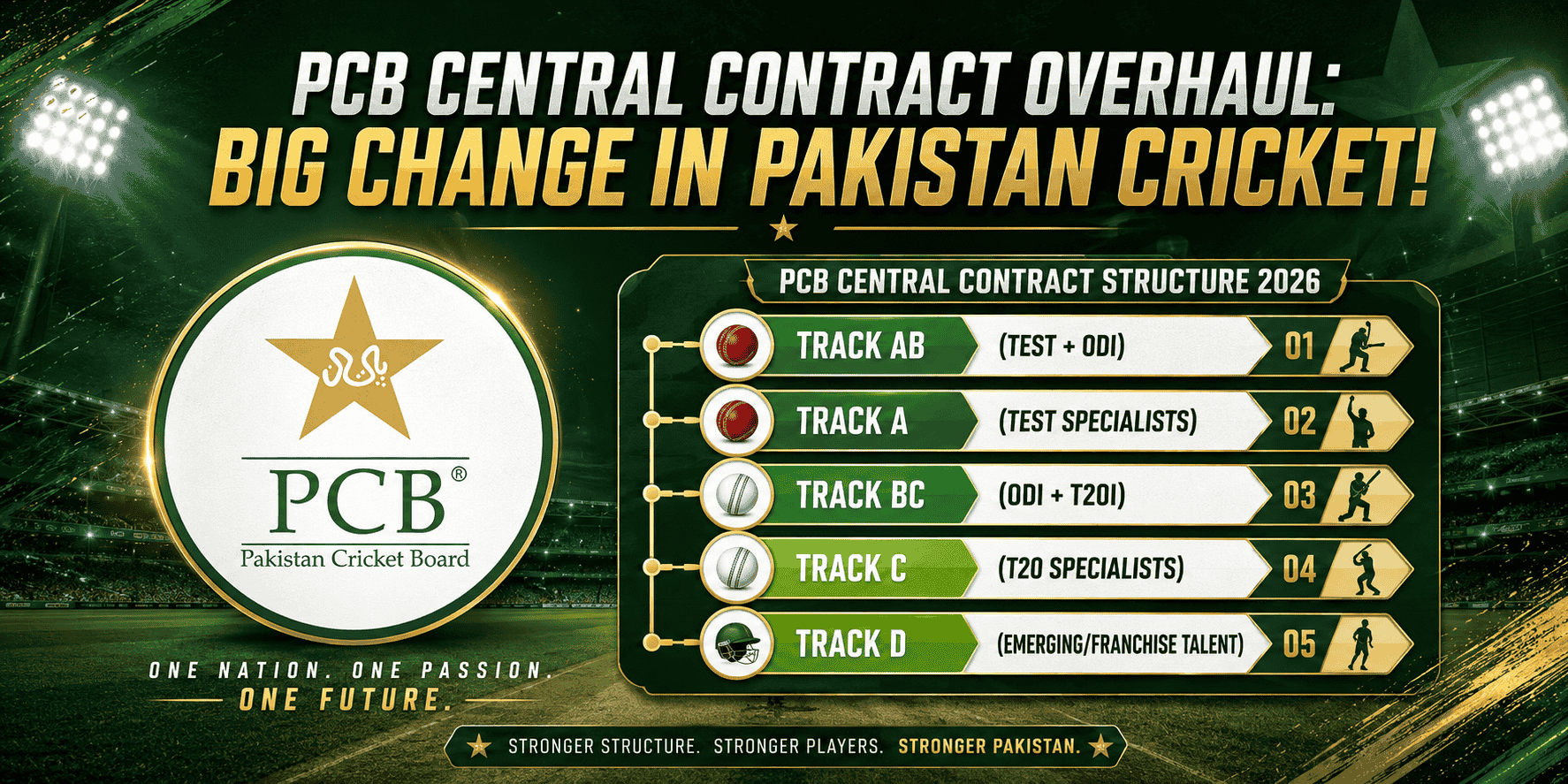
Under the old system, players from all formats (Test, ODI, and T20) were weighed on the same scale. However, this will no longer be the case. The PCB has divided players into five different format tracks based on their specialization:
[PCB Central Contract Overhaul 2026]
│
├─► Track AB (Test + ODI)
├─► Track A (Test Specialists)
├─► Track BC (ODI + T20I)
├─► Track C (T20 Specialists)
└─► Track D (Emerging/Franchise Talent)
1. Track AB: The Elite All-Format Track
This is the top-tier track. It will accommodate players who are integral to Pakistan's Test and ODI formats. These players will receive the highest monthly retainers and respect, as they bring glory to the country in both difficult formats.
2. Track A: Test Cricket Specialists
Pakistan has always been a bit unfair to its red-ball (Test) players, as T20 players earned more money. In this new system, Track A has been created only for Test specialists. Its aim is to save Test cricket and provide financial security to red-ball players. According to a report, the top-tier player of Track A will get a monthly retainer of Rs 4 million (40 Lacs).
3. Track BC: White-Ball Regulars
This track features players who play both ODIs and T20Is. These players are the lifeblood of white-ball cricket. They will be paid a match fee of ₹750,000 per ODI match and ₹500,000 per T20I match.
4. Track C: T20 Format Specialists
There are some players who specialize solely in the short format, such as T20Is. Track C has been specially designed for them. They will be paid based on their T20I performance..
5. Track D: Emerging and Franchise Talent
This track is for our new and upcoming young stars. It will feature domestic performers and T20 league specialists who haven't yet established themselves at the international level but have immense potential.
Not only this, but except for Track D, two separate tiers have been created within each track, i.e., Tier 1 and Tier 2. Players whose current performance is very excellent will be placed in Tier 1, and hence their monthly retainer i.e., salary) will also be higher. On the other hand, Tier 2 will accommodate those players who are a little less experienced or whose performance has deteriorated a little; hence, their retainer will be kept a little lower than Tier 1. But let us remind you that whether you are in Tier 1 or Tier 2, all the rules and NOC criteria of international and domestic cricket will be exactly the same for everyone.
In this new contract structure, a new principle of Eligibility Gates has been introduced, which clearly means "Play First, Then Get Contract". Pakistan Cricket Board (PCB) has now completely stopped the practice of getting a contract for free without playing. Now, to be included in the new system, a minimum international appearance criterion has been imposed on the players. To get a central contract (like Tracks AB, A, BC, or C), any player must have played at least 4 Tests, 6 ODIs, or 6 T20Is during the last 12 months.
However, this strict new principle offers a small caveat: this rule doesn't apply only to Track D or emerging players. The biggest benefit of this type of gatekeeping will be that players who remain benched or remain out citing injuries will now lose their central contracts. With this new and strict system in place, only those players who are actively playing cricket for the country will be able to earn money.
PCB New Central Contracts
| Track Category | Tier Type | Estimated Monthly Retainer (PKR) | Match Fee Highlights |
| Track AB (All-Format Elite) | Tier 1 | High Premium Level | Full Test & ODI Match Fee |
| Track A (Test Only) | Tier 1 | Rs 4.0 Million (40 Lakh) | Enhanced Test Match Fee |
| Track A (Test Only) | Tier 2 | Rs 3.6 Million (36 Lakh) | Enhanced Test Match Fee |
| Track BC (White-Ball Regulars) | General | Performance-Based | ODI: 7.5 Lakh | T20I: 5.0 Lakh |
| Track D (Emerging Talent) | Base | Development Retainer | Domestic Standard Rates |
Strict rules: Domestic cricket and the ban on knocking
Mohsin Naqvi and his management (which includes big names like Aaqib Javed and Mike Hesson) have put in place some very strict rules to curb the tantrums of the players:
- Mandatory Domestic Cricket: Now, no player can simply walk away from domestic cricket, saying they're tired. If you want to play for Pakistan, you'll have to be present in domestic tournaments.
- Strict NOC Policy for Foreign Leagues: Earlier, players used to skip national duty and go to play in foreign leagues (like ILT20, BBL, or MLC). Now, strict benchmarks have been set for each track. If you do not meet the criteria, you will not get an NOC to play in the league. Especially for Test specialists (Track A), the avenues to play in other leagues have been restricted to a great extent so that they remain fresh.
- Zero Tolerance for Indiscipline: If any player attempts to create factionalism within the team or speaks against the board in the media, their contract will be cancelled outright.
PCB's new Central Contract Overhaul looks very elegant and professional. This model is perfectly in keeping with modern cricket, where data is prioritized over human emotions. Giving Test specialists their due and cracking down on players chasing T20 leagues is a highly commendable step.
But the real test will come when this new framework is implemented on the ground. Will our biggest star players quietly accept this strict policy, or will it spark another controversy? Only time will tell.
Spotted an error in this article? Let us know via our corrections page. Read about how we work in our editorial policy.