HBL PSL 2026 (Season 11): 8 Teams, New Format & Full Fixture
HBL PSL 2026 (Season 11): The Dawn of an 8-Team Era and Pakistan’s Golden Cricket Revolution
The Pakistan Super League (PSL) has transcended being just a twenty-over cricket tournament; it has morphed into a national identity, a symbol of resilience, and a month-long festival that captures the global cricketing imagination. Since its inception in 2016, the league has grown from a fledgling project in the UAE to a powerhouse of T20 cricket hosted entirely in Pakistan.
However, the year 2026 marks a watershed moment. PSL 11 is not just another season; it is the "Big Bang" of Pakistani franchise cricket. With the expansion to eight teams, a revamped competitive format, and a multi-city caravan that touches every corner of the country, PCB is setting the stage for what many experts believe will be the most commercially successful and competitive league in the world after the IPL.
In this deep dive, we explore the structural evolution of the league, the tactical nuances of the new format, the cultural impact of the new franchises, and the economic windfall this "Golden Era" promises for Pakistan.
The Evolution: From 5 to 8 Teams (2016–2026)
The journey of the PSL is a story of organic growth. In 2016, the league started with five foundational pillars: Islamabad United, Karachi Kings, Lahore Qalandars, Peshawar Zalmi, and Quetta Gladiators. By Season 3, the inclusion of Multan Sultans added a southern flavor and a sixth powerhouse.
For years, critics and fans alike argued that a country with a population of 240 million and an endless supply of raw cricketing talent was "under-served" by only six teams. The "bench strength" of Pakistan was so deep that international-quality players were often sitting in the dugouts. Recognizing this, the PCB has finally pulled the trigger on a long-awaited expansion.
The New Challengers
The entry of two new franchises in 2026 changes the geography of the league and creates new, high-voltage rivalries.
I. Hyderabad Kingsmen: The Pride of Sindh
For too long, the province of Sindh was represented solely by Karachi. The birth of the Hyderabad Kingsmen changes that dynamic. Hyderabad, with its historic Niaz Stadium and a legacy of producing gritty cricketers, finally has a seat at the high table.
- The Impact: This creates the "Sindh Derby." Much like the fierce "El Clasico" of Pakistan (Lahore vs. Karachi), the Karachi Kings vs. Hyderabad Kingsmen matches are expected to be emotional, high-stakes encounters that will galvanize the interior Sindh region.
II. Rawalpindi Pindiz: The Home of Speed
Rawalpindi has always been the "fast-bowling capital" of the world, producing icons like Shoaib Akhtar. While the city previously shared its loyalties with Islamabad United, the residents of the "Twin Cities" now have a distinct choice.
The Impact: The Rawalpindi Pindiz bring a "street-smart" and aggressive brand of cricket. The "Twin Cities Derby" against Islamabad United is predicted to be the most-watched group-stage fixture, as bragging rights for the Potohar region are put on the line.
Navigating the New Group Stage: A Tactical Masterstroke
Expanding to eight teams presented a logistical nightmare: how to keep the tournament concise while ensuring fairness? A traditional "Double Round Robin" (where every team plays everyone twice) would have resulted in 56 group matches plus playoffs, stretching the league to nearly 65 days.
To maintain the high-octane intensity the PSL is known for, the PCB introduced a Hybrid Group Format.
The Breakdown of the 10-Game Model
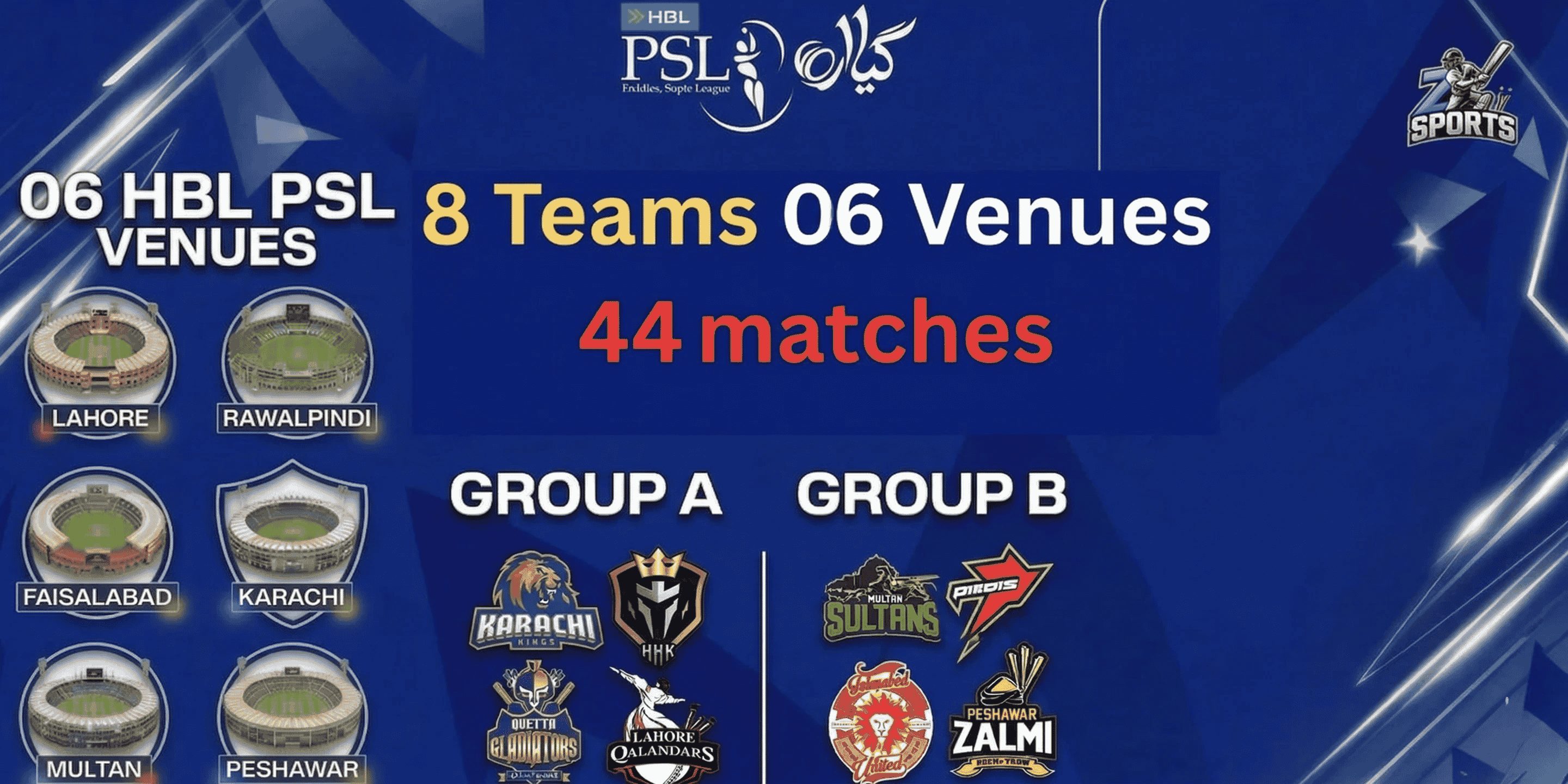
The eight teams are divided into two groups of four (Group A and Group B).
- Intra-Group Rivalries (6 Matches): Each team plays the other three teams in its own group twice—once at home and once away. These "double encounters" ensure that local rivalries are fully exploited.
- Inter-Group Clashes (4 Matches): To ensure every team faces every opponent in the league at least once, teams will play a single "cross-over" match against the four teams in the opposite group.
- The Leaderboard: After each team completes its 10 matches, all eight teams are ranked on a single, unified points table. The top four teams from this combined list advance to the Playoffs.
This format strikes a perfect balance. It keeps the total match count manageable (around 44-46 matches) while ensuring that every match remains a "must-win" for qualification.
Venues and Atmosphere: Mapping the Cricket Fever
For PSL 11, the PCB has moved away from the "two-city" model of the past. The 2026 season is designed as a nationwide tour, bringing world-class cricket to six different cities.
Lahore (Gaddafi Stadium) – The Grand Theatre
As the heart of Pakistan cricket, Lahore takes the lion's share of the action with 15 matches.
- Key Events: The Opening Ceremony, the Opening Match (March 26), both Eliminators, and the Grand Final (May 3).
- The Vibe: The Gaddafi Stadium, with its revamped infrastructure and electric atmosphere, remains the ultimate destination for players and fans.
Rawalpindi (Pindi Cricket Stadium) – The Run-Feast
Known for its flat tracks and short boundaries, Pindi will host 11 matches.
- Highlight: Qualifier 1 will be held here. The "Pindi Boys" are famous for their vocal support, and the stadium often records the highest decibel levels in the league.
Faisalabad (Iqbal Stadium) – The Industrial Heartbeat
The return of PSL to Faisalabad after a long hiatus is perhaps the biggest win for local fans. Hosting 7 matches, the Iqbal Stadium will see a resurgence of cricket culture in the industrial hub of Punjab.
Karachi (National Bank Arena) – The Tactical Battleground
While Karachi hosts fewer matches this year (6 matches), the quality of cricket is expected to be supreme. The coastal humidity and sea breeze offer a unique challenge for bowlers, making these "High-Intensity" clashes a tactical treat.
Multan (Multan Cricket Stadium) – The Fortress of the South
Multan has become a "must-visit" venue. Hosting 4 matches, the "City of Saints" provides a picturesque backdrop and a fiercely loyal fan base for the Multan Sultans.
Peshawar (Arbab Niaz Stadium) – The Historic Homecoming
In a move that signals the complete normalization of cricket in Pakistan, Peshawar will host 1 historic match. This is a powerful message to the world that every corner of Pakistan is safe and ready for international sport.
The Economic and Social Revolution
PSL 11 is more than a sporting event; it is a massive economic engine. The transition to eight teams has created a multiplier effect on the Pakistani economy.
Sponsorship and Broadcasting Rights
With more teams and more matches, the valuation of the PSL has skyrocketed. New sponsors, ranging from tech startups to international FMCG brands, have poured millions into the league. The broadcasting rights for Season 11 have reportedly broken all previous records, providing the PCB with the "Oxygen Mask" needed to fund domestic grassroots cricket.
Tourism and Local Business
The "6-City Model" acts as a catalyst for local industries. Hotels in Faisalabad and Multan report 100% occupancy during match weeks. Transport services, street food vendors, and official merchandise sellers see a massive surge in revenue, proving that the PSL is a "People’s League."
The Talent Factory
The jump to eight teams means roughly 40 additional slots for professional cricketers. This allows the PCB to fast-track young talent from the Under-19 and domestic circuits directly into a high-pressure environment. The next "Shaheen Afridi" or "Babar Azam" is likely to be discovered in the ranks of the Hyderabad Kingsmen or Rawalpindi Pindiz this year.
The Road to the Trophy: The Knockout Phase
The business end of the tournament begins on April 28, 2026. The Playoff system remains the fairest way to determine a champion:
- Qualifier 1 (Rawalpindi): The top two teams battle for a direct ticket to the final.
- Eliminator 1 (Lahore): The 3rd and 4th placed teams fight to stay alive. The loser goes home.
- Eliminator 2 (Lahore): The loser of Qualifier 1 gets a second chance against the winner of Eliminator 1.
- The Grand Final (May 3, Lahore): The culmination of 39 days of grueling cricket.
Conclusion: A New Horizon for Pakistan
HBL PSL 11 is a testament to how far Pakistan cricket has come. From playing in empty stadiums in Dubai to hosting an 8-team extravaganza across six home cities, the journey has been nothing short of miraculous.
This season is not just about who lifts the trophy; it’s about the smiles on the faces of fans in Faisalabad, the roar of the crowd in Peshawar, and the global recognition of Pakistan as a premier cricketing destination. On March 26, when the first ball is bowled, the world will witness a nation united by a single passion.
Pakistan Cricket ka Sunehri Daur (The Golden Era of Pakistan Cricket) has officially arrived.