Salman Ali Agha's Controversial Run-Out: Mehidy Hasan's "Cunning" or Killing the Spirit of Cricket?

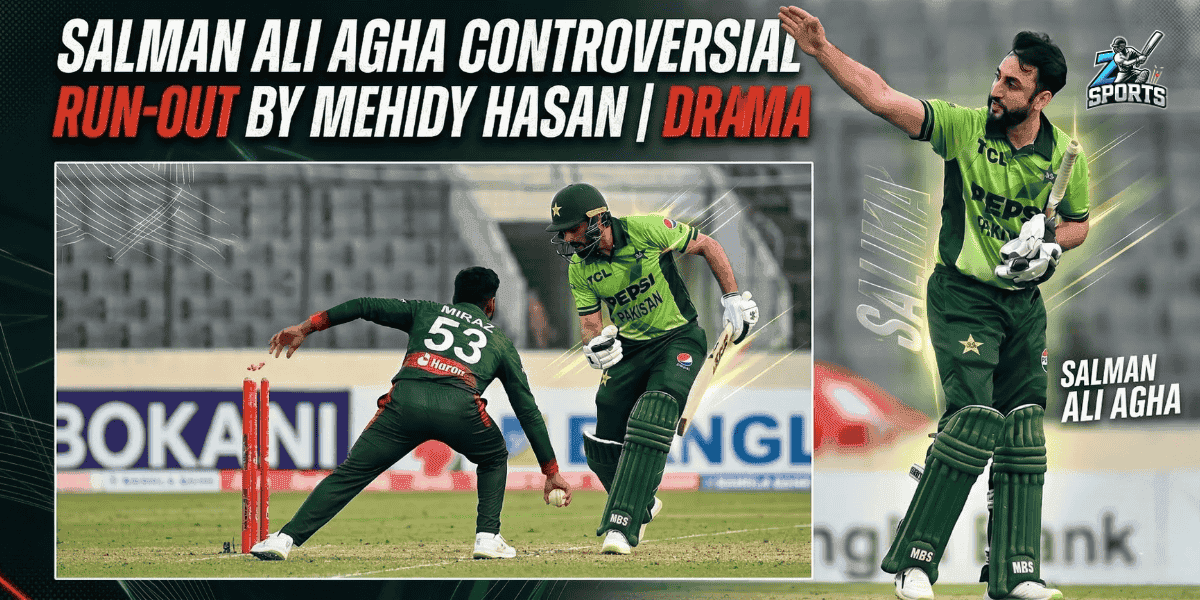
There have been numerous occasions in cricket history when the "Spirit of Cricket" has been debated, but what happened at the Sher-e-Bangla Stadium in Mirpur on March 13, 2026, has sparked a new controversy. In the second ODI between Pakistan and Bangladesh, a moment occurred that divided fans and experts around the world. Salman Ali Agha's strange and mysterious run-out wasn't just a wicket, but a story that will be talked about for years.
Match Scenario: When Pakistan Was Strong
The mood of the match was excellent for Pakistan. At one point, it seemed as if Pakistan would easily win the match and level the series 1-1. Mohammad Rizwan and Salman Ali Agha had forged a brilliant partnership of 109 runs. Salman Ali Agha was playing with full confidence, scoring 64 runs, and Bangladesh's bowlers were looking helpless. The 39th over was underway, and the stadium was silent as Pakistan was cruising towards victory.
Agha has always been an anchor in Pakistan's batting line-up, and that day too, he stood like a strong pillar to achieve the big target again. Bangladesh's bowlers were tired and the ground fielding was also showing sluggishness. In such a situation, no one had even thought that a wicket would fall which would change the course of the game.
That moment when everything changed: "Helping Hand" or "Mistake"?
The controversy started when Mohammad Rizwan lightly defended a ball from Bangladesh captain Mehidy Hasan Miraz. The ball went a little way and stopped near the non-striker's end. Salman Ali Agha, known for his sportsmanship, saw that the ball had stopped. He assumed the ball was "dead," so he stepped out of his crease to pick it up and return it to the bowler (Mehidy Hasan). This is a common practice in cricket that batsmen often do to help the bowler so as not to waste time.
But Mehidy Hasan Miraz had something else on his mind. As soon as he saw that Agha was out of the crease, he quickly ran towards the ball. Agha was just picking up the ball when Miraz caught it and gave bails. The Bangladesh team appealed vehemently. Everyone on the field was stunned. The on-field umpire sent the decision to Third Umpire Kumar Dharmasena. Replays clearly showed that Agha wasn't intending to take a run, but rather was simply returning the ball, but technically he was out of the crease.
Law vs. Spirit: Expert Verdict
The fall of this wicket sparked a storm on social media. Cricket experts began offering their opinions. This argument wasn't limited to just the fans, even the veteran players strongly condemned it.
Ramiz Raja's statement: "This is not the way to win. Being competitive is good, but sacrificing sportsmanship is a disgrace to cricket. We want to see a contest of skills, not bluffing. If we keep taking wickets like this, then the batsman will never help the bowler."
Mehidy Hasan Miraz's defense: Bangladesh's captain showed no embarrassment in the post-match press conference. He said, "The rules are absolutely clear. The ball was in-play and the umpire didn't call it a dead ball. I'm the captain and my job is to win for my team. In cricket, friendship happens off the field, not on it."
Salman Ali Agha's Rad-e-Amal: Agha, expressing shaded anger, said, "I was just helping him. If I had known that the Spirit of Cricket had been lost here, I would never have left the crease. I've always learned to respect the game, but today I felt hurt."
What does the rulebook say? (Technical Analysis)
If we look at the ICC laws, according to ICC Law 31.7, the ball remains active until it is in the hands of the wicket-keeper or the bowler, or the umpire declares it "dead." Furthermore, there is a fine line between "obstructing the field" and "run-out." Technically, what Mehidy Hasan did was within the rules. But the issue here is one of ethics. When a player is helping you and you give him out, it is considered against the centuries-old tradition of cricket.
Dharmasena gave the same decision as was shown on the screen. He said that he was bound to make his decision based on the law, not on emotions. However, cricket fans around the world declared it unfair play.
Anger and Pakistan's Collapse
Salman Ali Agha was so enraged by this decision that he slammed his helmet and gloves into the ground as soon as he crossed the boundary. He was also fined 15% of his match fee for this action. After this wicket, Pakistan's team came under pressure. The team, which was easily on its way to a 250+ score, suddenly collapsed.
Pakistan lost its next seven wickets for just 43 runs. Bangladesh fans created a lot of noise in the stadium, which put Pakistan's junior batsmen under tremendous pressure. Although Pakistan won the match by 128 runs (due to the DLS method), the joy of this victory was completely ruined as the atmosphere of the match became toxic.
Is this a "Mankading" incident?
Many people compare this incident to Ravichandran Ashwin's "Mankad" style run-out. But there is a difference between the two. In Mankading, the batsman tries to cover ground cleverly, whereas Salman Ali Agha's intention here was simply to give the ball to the bowler. Therefore, this incident seems funny and "unethical" because the batsman's intention was not to gain any advantage.
Conclusion: A memorable confrontation
This incident has now become a permanent part of the cricket rivalry between Pakistan and Bangladesh. It will be remembered as the "Mirpur Ambush" or the "Dhaka Drama." Cricket experts are now suggesting that batsmen no longer need to be "extra polite" on the field.
Was what Mehidy Hasan did right? Or should Salman Ali Agha not have been so "innocent"? These debates will continue, but one thing is certain: Modern cricket is no longer just a game of bat and ball; it has become a platform for cleverly exploiting the nuances of the rules. For Bangladesh it was an attempt to win, but for Pakistan it was a betrayal.
Spotted an error in this article? Let us know via our corrections page. Read about how we work in our editorial policy.